.jpg)



Part 2 of a 3-part series
By Mufid Abdulla:
In 1979 the Ayatollah Khomeini overthrew the Shah and began to establish an Islamic theocracy in Iran. In the same year Saddam Hussein formally seized power in Iraq. With the biggest ground force in the region and Iran still in chaos Saddam saw an opportunity through a quick war to settle in his favour the ancient dispute over the Shatt al Arab and prove Iraq’s regional dominance. However, the Iraq attack on Iran proved to be a gift for the Ayatollah who used the external threat to galvanise his supporters and wipe out internal rivals. A ten-year war ensued in which one million died and the boundaries between the two countries ultimately stayed unchanged. The role of Iraq’s Kurds in this futile conflict was tortuous and tragic. It also preceded the establishment of a de-facto, although not self-proclaimed, Kurdish state.
In the first years of the conflict the KDP was funded by Iran, and helping it to suppress the Iranian Kurds in the Kurdish Democratic Party of Iran (KDPI), while the PUK was in negotiations with Saddam.
When the KDP helped Iran seize an Iraqi border town, Saddam took his revenge by rounding up all the male members of the Barzan tribe who had previously been deported to camps in southern Iraq. Around 8,000 Barzanis, young and old, were paraded through Bagdad and then they were loaded into trucks and disappeared. “They betrayed the country” Saddam announced on state television, “and we meted out a stern punishment to them and they went to hell” (1).
Saddam also jettisoned his peace talks with Talabani’s PUK for two reasons: pressure from Turkey and backing from the USA. The Turkish government was involved in a gruelling struggle with the Turkish Kurd guerrilla movement, the Kurdish Workers Party (PKK), and it was terrified that any concessions made by Saddam to Iraqi Kurds would embolden the Kurds in Turkey. It threatened to shut down Iraq’s main oil pipeline if Saddam signed a deal with the Talabani. This was enough to scupper any deal but the US intervention also helped convince Saddam that he no longer needed to negotiate with the PUK.
US courts Saddam
In the 1970s US policy in the region had been dictated by Cold War imperatives: Iraq was getting weapons from the Soviet Union and therefore ‘hostile’ while the Shah of Iran was a ‘friend’ of the West. The triumph of Iran’s mullahs – with their anti-imperialist rhetoric and commitment to helping establish theocracies across the region – changed everything. If Saddam lost the war Iran could forge an alliance with Iraq’s majority Shia population and become the strongest power in the region threatening US oil supplies and the US-supporting Sunni Arab regimes. In December 1983 US President Reagan sent Donald Rumsfeld as a special envoy to meet Saddam and inform him that the defeat of Iraq would be contrary to US regional interests. There followed economic and military support from the US, Britain, France and other countries. The support kept flowing to Iraq despite growing evidence that, contrary to the Geneva Convention, Saddam was using mustard gas shells and other chemical weapons against the Iranians. Saddam was a tyrant but, at this point, he was the American’s tyrant.
As the US commentator Peter Galbraith noted:
“..Reagan’s courtship of Saddam was not just about blocking an Iranian victory in the war. The president and his team saw in Saddam Hussein a potential partner in the Middle East, both politically and economically. By seeing in Saddam what he wanted to see, Reagan overlooked and then became an apologist for gross human rights violations, the use of poison gas and ultimately genocide” (2).
Anfal
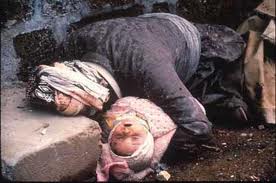
The ceasefire between Iraq and the PUK ended. Talabani made peace with Tehran and signed a pact with the KDP in 1986, forming the Kurdistan National Front together with other smaller parties and moving to unify the peshmerga forces. Saddam responded with a diabolical attack on the Kurdish civilian community. He appointed his cousin General Ali Hasan al Majid as governor of northern Iraq and gave him absolute powers to resolve the Kurdish problem. Al Majid (‘Chemical Ali’) set up his office in Kirkuk and began his Anfal campaign of deportations and extermination, designed to wipe out the peshmerga and destroy the spirit of the Kurdish people. In this process the Kurdish town of Halabja acquired the same tragic status as did Guernica in the Spanish Civil War. In March 1988 the Iraqis responded to the capture of Halabja by PUK and Iranian forces by bombarding the town with chemical weapons and high explosives:
“Dead bodies, human and animal littered the streets, huddled in doorways, slumped over the steering wheels of their cars. Survivors stumbled around, laughing hysterically before collapsing…”(3).
For three days, the town and surrounding districts were mercilessly attacked with bombs, artillery fire, and chemicals. 5,000 people died immediately and it is estimated that the chemical attacks claimed around 12,000 lives in all, as well as causing long-term diseases, miscarriages and birth defects.
The gases used included mustard gas, nerve agents, sarin, tabun and VX. This was the biggest-ever chemical attack on a civilian population. Of all the atrocities committed during the Anfal campaign, Halabja has come to symbolise the worst of a time of fiendish repression. Kurds all around the world have family members or friends who lost their lives or suffered horrifically at the hands of the Iraqi regime.
Kurdish morale was severely undermined by the terror induced by gas attacks. When the PUK tried to open peace talks, al Majid responded contemptuously. “Jalal Talabani asked me to open a special channel of communication with him”, he said in one taped phone call, later replayed at his trial for war crimes after the fall of Saddam. “That evening I went to Sulamanaiya and hit them with the special ammunition. That was my answer. We continued the deportations”.
Al Majid felt he could act with impunity “I will kill them all with chemical weapons” he said in another taped call. “Who is going to say anything? The international community? **** them!”(4) In fact, to quote the Financial Times, “the international community’s response to the Kurds mounting cries of alarm has so far been a deafening silence”(5). An attempt to push a Prevention of Genocide Act through the US Congress was defeated partly due to the influence of the US rice lobby which was benefiting from increased trade with Iraq.
By the end of the Iran-Iraq war around 4,000 Kurdish villages were destroyed and around 1.5 million people had been forcibly resettled. Between 150,000 and 200,000 had been killed, including through gas attacks and mass executions. In July 1989 the Kurdistan National Front estimate that 45,000 out of 75,000 square kilometres of Kurdistan had been cleared of Kurds.
From Gulf War to ‘No Fly Zone’
When it seemed that Kurdish fortunes were at their lowest ebb, the tide suddenly turned following Saddam’s foolhardy decision to invade Kuwait in 1990. Iraq’s economy had been drained by the war and Saddam wanted to seize the Kuwaiti oil fields thinking the US would continue turn a blind eye to his predatory activities. However, the invasion alarmed Saudi Arabia and other pro-US Arab regimes and President George Bush decided to cut Saddam down to size. The Gulf War began in January 1991 and Iraqi forces were soon retreating from Kuwait and surrendering in huge numbers.
In a speech on 15 February President Bush made a surprising announcement: “There’s another way for the bloodshed to stop, and that is for the Iraqi military and the Iraqi people to take matters into their own hands and force Saddam, the dictator, to step aside” (6). Iraq’s Shias and Kurds took this as a clear signal that the Americans would support them in uprisings against the regime. But this was not the case: Bush’s real objective was to encourage a military coup against Saddam and the installation of a more compliant leader. As a senior official put it to Peter Galbraith: “Our policy is to replace Saddam Hussein, not his regime” (7). By the end of the war Saddam’s conscript army was defeated but his elite Republican Guard remained intact. When the Shias rose against the Baathists in Basra, Saddam sent the Republican Guard, led by Ali Majid, to crush them. Around 300,000 Shias were massacred under the noses of US troops. The Americans even allowed the Iraqi regime to use helicopter gunships to attack the Shia rebels.
On 4 March 1991 a spontaneous uprising began in the Kurdish town of Raniya and it quickly spread throughout the region. “The uprising came from the people themselves. We didn’t expect it”, admitted KDP leader Masud Barzani (8). The turning point came when the majority of the jash leaders – tribal leaders of Kurdish troops fighting alongside the Iraq army – changed sides, no doubt encouraged by the Kurdistan National Front’s announcement of an amnesty for them. To quote McDowell: “The majority of jash leaders were thus transformed from embarrassed collaborators with Baghdad into champions of the uprising”(9). The forces of the Front suddenly grew from 15,000 to more than 100,000 and they pushed southwards, capturing Kirkuk on 19 March 1991.
However, having crushed the Shias in the south, Saddam was able to counter-attack in Kurdistan with his Republican Guard, heavy weapons and airpower. The USA did nothing.
“It now appeared that the US-led coalition did not wish Baghdad to lose control of the country or rather, as indicated in unattributable briefings, that it desired the defeat of the rebels before the overthrow of Saddam Hussein. It was also clear that the US wished to assure Turkey and Saudi Arabia that it would help neither the Kurds nor the Shias” (10).
After the Iraqi army recaptured Kirkuk, and pressed north, terror swept through a Kurdish population anticipating Saddam’s terrible revenge. 1.5 million Kurds abandoned their homes and fled to the Iranian and Turkish borders, sometimes being attacked with phosphorous bombs dropped from Iraqi helicopters.
“The whole of Kurdistan was flowing up the road”, reported BBC correspondent Jim Muir. “They used any kind of vehicle you can imagine – things like bulldozers with a scoop full of children. People (were) fleeing from hospitals – with IV drip feeds hanging off and people in beds rolling along – because someone said they’d smelled poison gas” (11).
While Iran opened its borders, Turkish guards beat Kurdish refugees with rifle butts. The Turkish government was terrified that by taking on half a million Iraqi Kurds it would fuel the fires of the PKK (Turkish Kurd) insurgency. Hundreds of thousands of Kurds, most of them city dwellers, made rough shelters on the snowy mountains tops.
For a while it seemed as if calls for a humanitarian intervention by the West would be ignored. “I don’t recall asking the Kurds to mount this particular insurrection”, commented the British Prime Minister John Major (12). However the UN Security Council passed a highly significant resolution on 5 April that condemned the Iraqi authorities, called on them to allow international humanitarian organisations to have access to Iraqi territory and mentioned the Kurds by name for the first time since the League of Nations ruling on Mosul in the 1920s. In mid-April the US-led Coalition forces that had defeated Saddam bowed to worldwide pressure by announcing the establishment of a ‘safe haven’ in north Iraq and prohibiting Iraqi planes from flying north of the 36th parallel into an area that included Erbil and Mosul but excluded Sulamaniyah and Kirkuk.
Weakened by war, Saddam was temporarily ready to negotiate and the Kurdish leaders’ willingness to make concessions caused alarms and cries of betrayal from other Iraqi oppositionists such as the Communists and the Shia parties. Masud Barzani was keen to strike a deal while Talabani, who had been photographed embracing Saddam at one of their meetings in Bagdad, was more wary. The negotiations dragged on for a few months, punctuated by some bloody clashes between Kurdish and Iraqi forces and, as winter approached, Saddam placed Kurdistan under siege, withdrawing his troops behind a defensive line, cutting off salaries to state employees and imposing a blockade. The population suffered greatly from lack of food and fuel and some people even took to the streets chanting, “We want bread and butter, not Saddam and not the Kurdistan Front”.
KRG established
The Front abandoned efforts to secure a deal with Saddam and decided it was time for Kurdistan to fully take control of its destiny. It announced plans to replace the old Legislative Assembly with a freely elected parliament and regional government. The elections, conducted under proportional representation, established a duopoly of the KDP, taking 45 per cent of the votes, and the PUK, which got 43.5 per cent. No other party secured the seven per cent required to win any of the 105 seats which were divided – 50 to each of the two main parties and five to parties representing the Asyrian minority in Kurdistan.
The Kurdistan Regional Government (KRG) was proclaimed. Initially, it had recognition from no other state. Jalal Talabani made overtures to the Turkish government resulting in the Turks supplying $13.5 million in aid to the KRG although this was in exchange for its acquiescence in a Turkish assault on PKK camps established on the KRG side of the border.
The KRG government was undermined from the outset by the ingrained mutual hostility of the two parties and the fact that real power rested not in the elected parliament but with Barzani and Talabani, even though both had opted not to take official state positions.
With the collapse of the Soviet Union, the PUK no longer espoused official ‘Marxism’ and there were no real ideological differences between the parties. But they operated competing systems of patronage, percolating from their leaderships down to communities they controlled. As McDowell put it:
“Thus following the demise of traditional tribalism as the prime form of socio-political organisation during the 1970s, the 1990s saw the emergence of neo-tribalism as two major ‘confederations’ competed for hegemony in Iraqi Kurdistan” (13).
References
1. Invisible Nation, Quil Lawrence, Walker, 2008, p, 31
2. The End of Iraq, Peter W Galbraith, Simon and Schuster, 2006, p. 20
3. Genocide in Iraq, Middle East Watch, p.109
4. Lawrence p.35
5. Financial Times, 23 March 1988
6. Galbraith p. 44
7. Galbraith p. 46
8. The Independent, 24 April 1991
9. McDowell, p. 371
10. McDowell, p.372
11. Lawrence p.52
12. ITN interview, 4 April 1991
13. McDowell, pp. 385-6

Thank you for this concise, informative article! I enjoyed both parts. Thank you again! 😀
[…] Genocide, diplomacy and the birth of the KRG | Kurdistan Tribune […]
xodjhlvsejtubousjcvof, vtissvcgvj , [url=http://www.ofmbfgcgdm.com]fhcftbreyp[/url], http://www.gfssidwmdf.com vtissvcgvj
Thanks for this wondeful post. i just hope many could read this for them to be inform.
Dude.. That’s not me much into reading, but somehow I got to learn a lot of articles on your own blog. Its amazing how interesting it’s for me to visit you frequently.